Empress Dowager Cixi was born on November 29, 1835 in Beijing, China. She was one of the concubines under the Xianfeng emperor. However, she was the only one to produce an heir to the throne. When her son as 6 years old, Xianfeng died. Her son became to be known as the Tongzi emperor and she became one of his councilors. He died at an early age so she adopted her three year old nephew that would keep her in power. She maintained her regent position which she shared with someone named Ci'an. But, Ci'an died and she became the only one with enough power to declare herself as Empress Dowager in 1881. At this time of her rise to power, the Qing dynasty was rapidly declining and needed to industrialize and modernize. She became everything China didn't need in order to maintain power and peace. She reversed advances by reverting back to old ways of thinking in regards to Confucianism. Her ultimate fall was humiliating. Her role was weakened by the Boxer Rebellion and she eventually was forced out of Beijing. She returned in 1902 and died on November 15, 1908.
https://www.britannica.com/biography/Cixi
Wednesday, March 29, 2017
Wednesday, March 22, 2017
The Rani of Jhansi
The rani or queen of Jhansi was quickly noted in chapter 14 under the section "The Revolt of 1857" and I felt a little ashamed that we do not give so much attention to women's reigns, legacies, or deaths in history. I decided that since March is the Women's History Month, I would like to elaborate more on who she was. Rani of Jhansi was named Manikarnika and was queen of the Maratha state Jhansi. She is remembered in Indian history as a hero and leading figure in the Indian Rebellion of 1857 against British imperialism.
At a young age, she was often called Manu and was raised by her father. She was well educated and even took up martial arts. She was born on November 19, 1835 and died on June 17, 1858. Her father worked in the courts giving her a higher status and she married the Raja (King) of Jhansi at the age of 14. Her husband died in 1853, so the protection of their people rested in her hands. When the British went from tolerant and enthusiastic of Indian culture to imperialistic, she gathered voluntary men and women to create an army that would defend Jhansi. She did not allow her people to surrender even when the British military made its way to Jhansi. She was able to escape, but later died of battle wounds on June 17, 1858.
In recent years, her story and pictures are used as a symbol of the Women's Movement in India.
http://www.liveindia.com/freedomfighters/jhansi_ki_rani_laxmi_bai.html
At a young age, she was often called Manu and was raised by her father. She was well educated and even took up martial arts. She was born on November 19, 1835 and died on June 17, 1858. Her father worked in the courts giving her a higher status and she married the Raja (King) of Jhansi at the age of 14. Her husband died in 1853, so the protection of their people rested in her hands. When the British went from tolerant and enthusiastic of Indian culture to imperialistic, she gathered voluntary men and women to create an army that would defend Jhansi. She did not allow her people to surrender even when the British military made its way to Jhansi. She was able to escape, but later died of battle wounds on June 17, 1858.
In recent years, her story and pictures are used as a symbol of the Women's Movement in India.
http://www.liveindia.com/freedomfighters/jhansi_ki_rani_laxmi_bai.html
Thursday, March 16, 2017
Sumo Wrestling
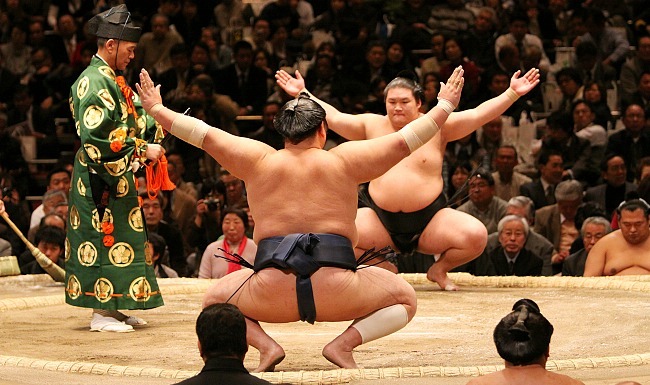
In honor of my and little baby sumo wrestler's (Fitzgerald's baby) birthday, I wanted to explore sumo wrestling. Sumo wrestling is a real, professional sport that is very popular in Japan. Sort of like wrestling here in the United States, two sumo wrestlers face off to be the best sumo wrestlers they can be, hopefully winning the grand champion title or yokozuna. Originally, sumo wrestling was a tool to entertain and appease Shinto deities. Many of the guidelines used when setting up the wrestling matches are still used today as they have been used in the past. However, the wrestlers do not only come from Japan. Many people around the world train to become sumo wrestlers. Most recently in 2017, an actual Japanese native won the yokozuna after 20 years. At a young age, sumo wrestlers have to leave their homes to eat, sleep, and train very hard. They also have to live a strict life to watch what they say and what they do in public as many people are looking up to them. Sumo wrestlers look the way they are portrayed in movies, however, it is a real life profession.
http://www.japan-guide.com/e/e2080.html
http://www.bbc.co.uk/newsround/38742096
http://www.japan-guide.com/e/e2080.html
http://www.bbc.co.uk/newsround/38742096
Wednesday, March 1, 2017
The Reign of Mao Zedong
Mao Zedong was the founding father of communist China, The People's Republic of China. This name would eventually conflict with Taiwan's Republic of China. Mao was a peasant and eventually went on to become a teacher. When reading and learning to become a teacher, he came across Marxism and was so fascinated in it that he founded the Chinese Communist Party. Mao Zedong is probably the most remembered for the "Great Leap Forward." This can be compared to the Soviet Union's change from a Tsar to a communist party. The whole point of the "Great Leap Forward" was to focus on and enhance industrialization and agriculture in China in the late 1950s through the expansion and use of laborers. However, he received much backlash because during this time, the people had suffered from famine. Again compared to the Soviet Union, like Joseph Stalin, Zedong purged China in 1966. This purge is known as the Cultural Revolution. Regardless of the harshness of his reign, Mao is still revered as one of the most important leaders of China. His picture can be found in many Chinese homes just as Stalin and Lenin are patronized by many Russians.
http://www.bbc.co.uk/history/historic_figures/mao_zedong.shtml
Wednesday, February 22, 2017
The Great Taj Mahal
The Taj Mahal is a great mausoleum built in 1632, in honor of the Mughal emperor Shah Jahan's most beloved wife, Mumtaz Mahal. Mumtaz Mahal died at the age of 39 during her 14th childbirth. She was Shah Jahan's favorite wife out of the three he was married to. He had commissioned the Taj Mahal to house her dead body, but it now houses her and him. The Taj Mahal was built out of all white marble and is designed in an Islamic fashion. Scriptures from the Quran can be found written in calligraphy above doorways. The Taj Mahal can be found right across the Yumana River and the capital of the Mughal Empire, Agra. Shah Jahan wanted to built a great mausoleum for himself, however his son Aurangzeb imprisoned him before he milked the Mughal Empire dry. Shah Jahan was buried next to his wife at the Taj Mahal. India has taken extensive measures in protecting the white marble by forbidding air-polluting factories and cars in the proximity of the Taj Mahal. http://www.history.com/topics/taj-mahal
Tuesday, February 14, 2017
Empress Wu
Empress Wu went by many names including Wu Zetian, Empress Consort Wu, Wu Hou, and Wu Zhao. She lived from 624 to 705 CE and reigned from 690 to 704 CE. She was the concubine to the first emperor of the Tang Dynasty, Taizong then married his son, Gaozong after he had a died. After her marriage to Gaozong, she became empress consort and gained more power by putting her sons on the throne then removing them.
Her life before coming a concubine was prestigious. She came from a wealthy family with a father as a chancellor. She studied and became literate. Taizong became fascinated with her when she was 14 and took her as his concubine and later as his secretary. However, she fell in love with his son Gaozong and had an affair with him, but she was not destined to be his concubine after Taizong's death. She had been sent to a nunnery, but Gaozong loved her so much that he had her back in court.
Once she came to power, the dynasty shifted from Tang to Zhou. She also gave many important roles to women in a patriarchal China. She promoted Buddhism in the country as well. She established well organized secret police and spy networks as she know the men of China would be highly unhappy with her reforms because of her being a woman and for many other policy reforms she set forth. She never really could escape her concubine tendencies and often took young men as her lovers. Double standards were set in place in China, so she received severe backlash for her numerous affairs.
Towards the end of her reign, she (like Stalin) purged her own administration due to her paranoia. In 704 CE, her health began to decline and she had to pass on the power to her son and his wife. The same year, she not only abdicated, but died.
http://www.ancient.eu/Wu_Zetian/
Her life before coming a concubine was prestigious. She came from a wealthy family with a father as a chancellor. She studied and became literate. Taizong became fascinated with her when she was 14 and took her as his concubine and later as his secretary. However, she fell in love with his son Gaozong and had an affair with him, but she was not destined to be his concubine after Taizong's death. She had been sent to a nunnery, but Gaozong loved her so much that he had her back in court.
Once she came to power, the dynasty shifted from Tang to Zhou. She also gave many important roles to women in a patriarchal China. She promoted Buddhism in the country as well. She established well organized secret police and spy networks as she know the men of China would be highly unhappy with her reforms because of her being a woman and for many other policy reforms she set forth. She never really could escape her concubine tendencies and often took young men as her lovers. Double standards were set in place in China, so she received severe backlash for her numerous affairs.
Towards the end of her reign, she (like Stalin) purged her own administration due to her paranoia. In 704 CE, her health began to decline and she had to pass on the power to her son and his wife. The same year, she not only abdicated, but died.
http://www.ancient.eu/Wu_Zetian/
Tuesday, February 7, 2017
The Warring States of China (Blog #5)
I asked Dr. Fitzgerald about the Warring States and I'm still curious as to how there were different states and the smallest ended up winning it all. When doing some more research, I stumbled across a page dedicated to the warring states period by San Jose State (http://www.sjsu.edu/faculty/watkins/warringstates.htm ) . The Warring States period lasted from 475 BCE to 221 BCE, 254 years! There was a larger state named Jin that had broken into some of the warring states: Han, Wu, and Zhao. The states to follow and add to the tension were Chu, Qi, and Yan. But, the smallest and victorious state ended up being the Qin. At this time, the Qin were not considered Chinese. They were considered barbarians, but the irony behind this that many Chinese still refer to themselves as Qin. Interestingly enough, during this period, it was not just all brutal fighting and wars. Confucianism was big during this time and Confucius's student Mencius was teaching during this time. A lot of attention was still being focused on education, Confucianism and how it outlines the way society should be ran, and art. The wars that broke out during this long period of time was to establish order and unity. After Shinghuandi died, the Qin ruled a little longer and then the Han Dynasty was established.
Subscribe to:
Posts (Atom)